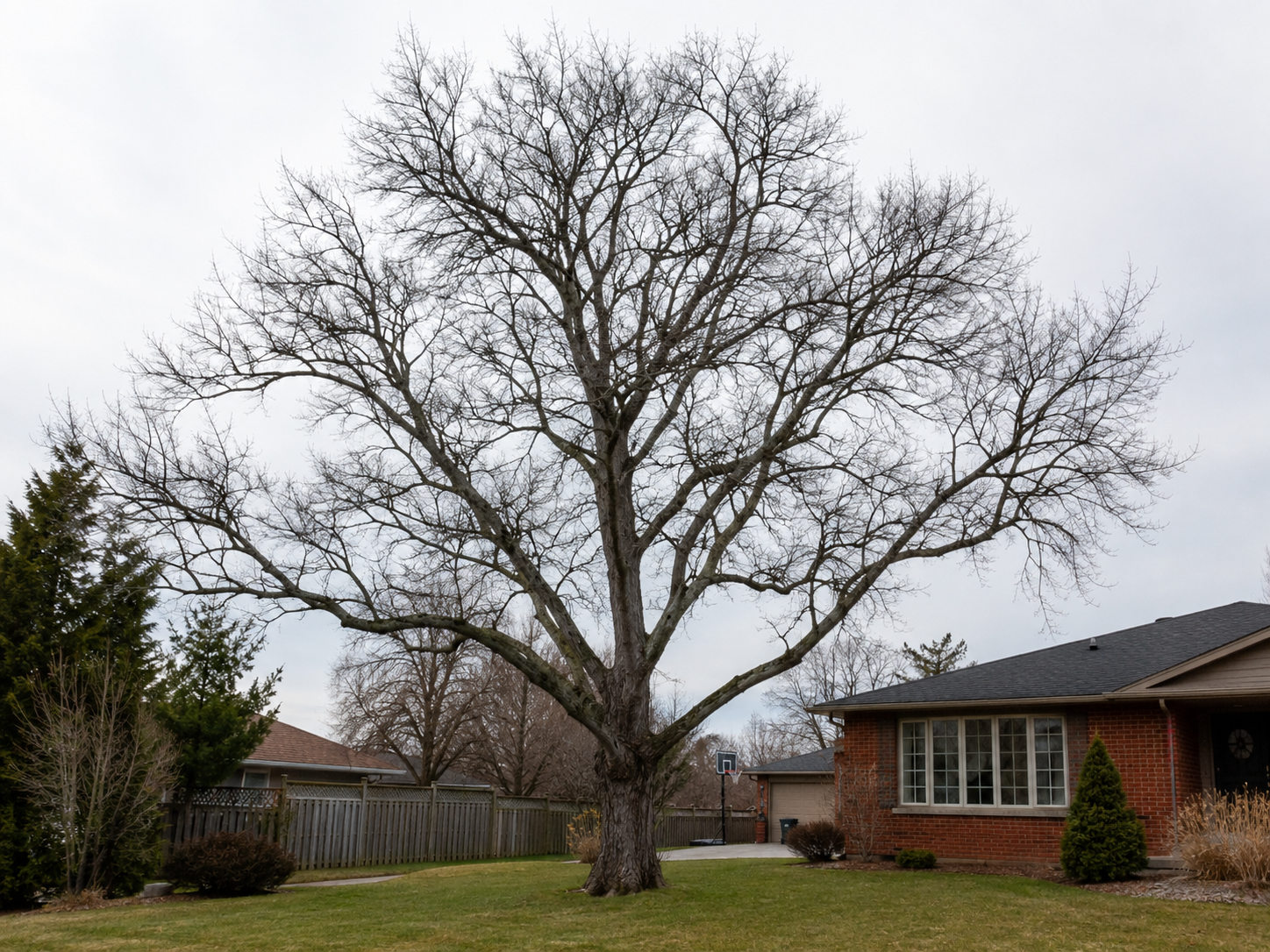
A dead tree is more than an eyesore. Once a tree stops producing healthy growth, the structure can weaken, branches can fail, and the risk around a home, driveway, fence, or walkway can increase quickly.
Some trees look dead during stress and recover. Others are already declining past the point where pruning will help. The key is knowing which signs matter before the tree becomes a safety issue.
Before checking individual branches, step back and look at the full shape of the tree. A dead tree often looks thin, brittle, uneven, or lifeless compared with nearby trees of the same species.
A tree may be in trouble if the canopy has large bare sections during the growing season. One dead limb is different from a whole side of the tree failing. Widespread canopy loss usually means the issue is deeper than a few broken branches.
Season matters here. A maple with no leaves in January is normal. A maple with no leaves in June needs attention. For Ontario homeowners, the most useful visual inspection usually happens from late spring through early fall, when healthy trees should be showing active growth.
Compare the tree to similar trees nearby. If every tree of the same type has leaves except one, that one deserves a closer look.
A tree that does not leaf out in spring may be dead, but timing matters. Some species leaf out later than others, and cold spring weather can delay growth across Ontario.
By late spring, most healthy deciduous trees should show buds, leaves, or some clear sign of life. If the canopy stays bare while surrounding trees are fully active, the tree may be dead or severely stressed.
Look for patterns. A few bare branches may point to localized dieback. A bare upper canopy, a dead main leader, or no new growth across the tree can indicate a more serious decline.
Homeowners in Simcoe County who are unsure whether a tree is stressed, diseased, or dying can use our guide on Tree Health Check Simcoe County as a starting point for what to inspect before deciding on next steps.
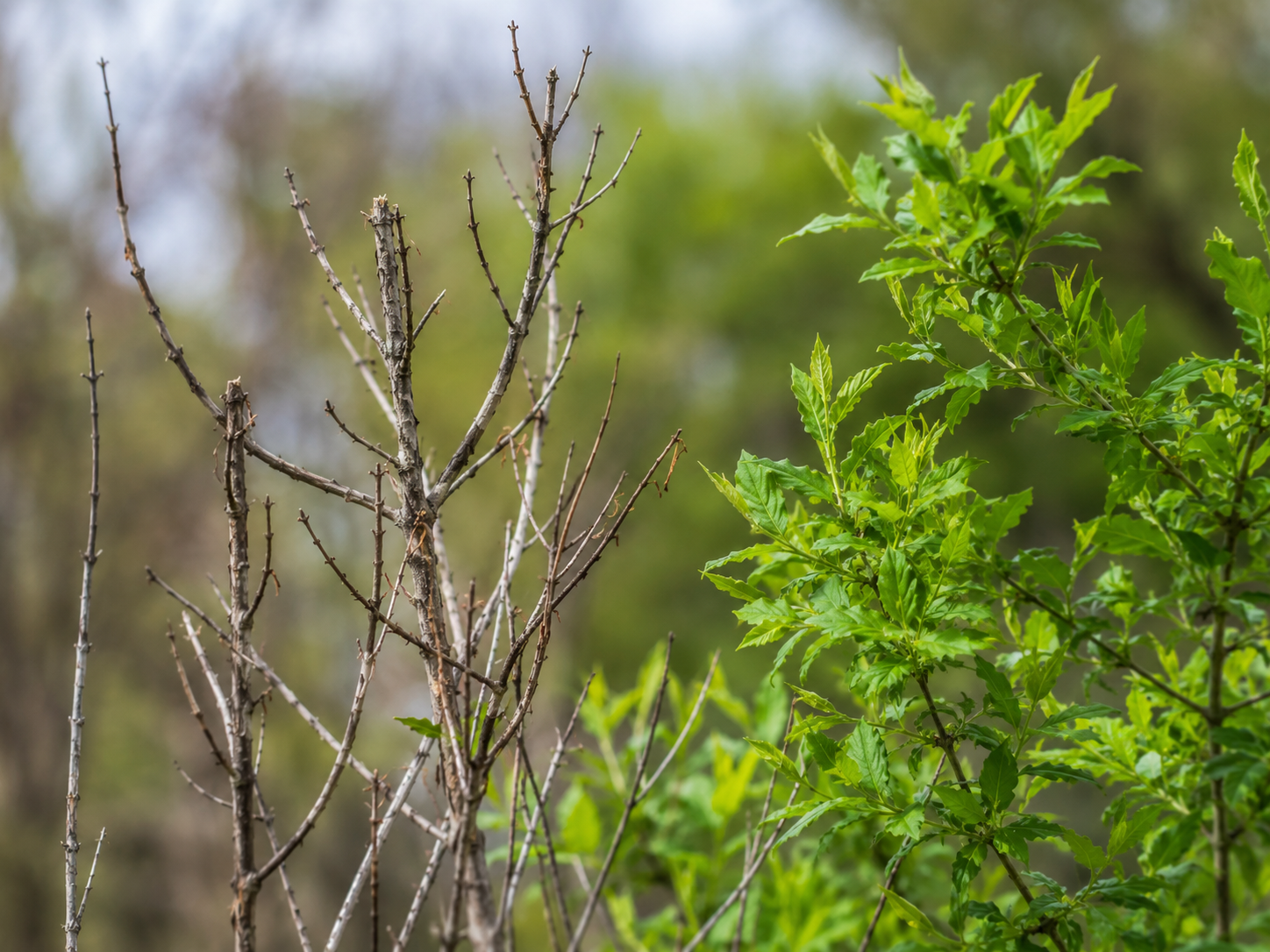
Dead branches are one of the clearest warning signs. They often appear dry, grey, cracked, or brittle. Smaller dead branches may snap easily in the wind, while larger limbs can become hazardous as decay moves through the wood.
A tree can survive with some deadwood, especially after storm damage or drought stress. The concern grows when dead branches are large, spreading through the canopy, or hanging over areas people use.
Common warning signs include dry twigs that snap easily, limbs with no buds, branches shedding bark, and sections of the canopy that no longer produce leaves. If these signs appear high in the tree or near heavy limbs, do not rely on a ladder and guesswork.
For Barrie homeowners dealing with dead limbs over driveways, yards, or rooflines, our article on Dead Limb Removal Barrie explains why deadwood should be handled before it breaks on its own.
After heavy snow, freezing rain, or strong wind, check the canopy from the ground. Freshly broken deadwood often reveals weak areas that were already declining.
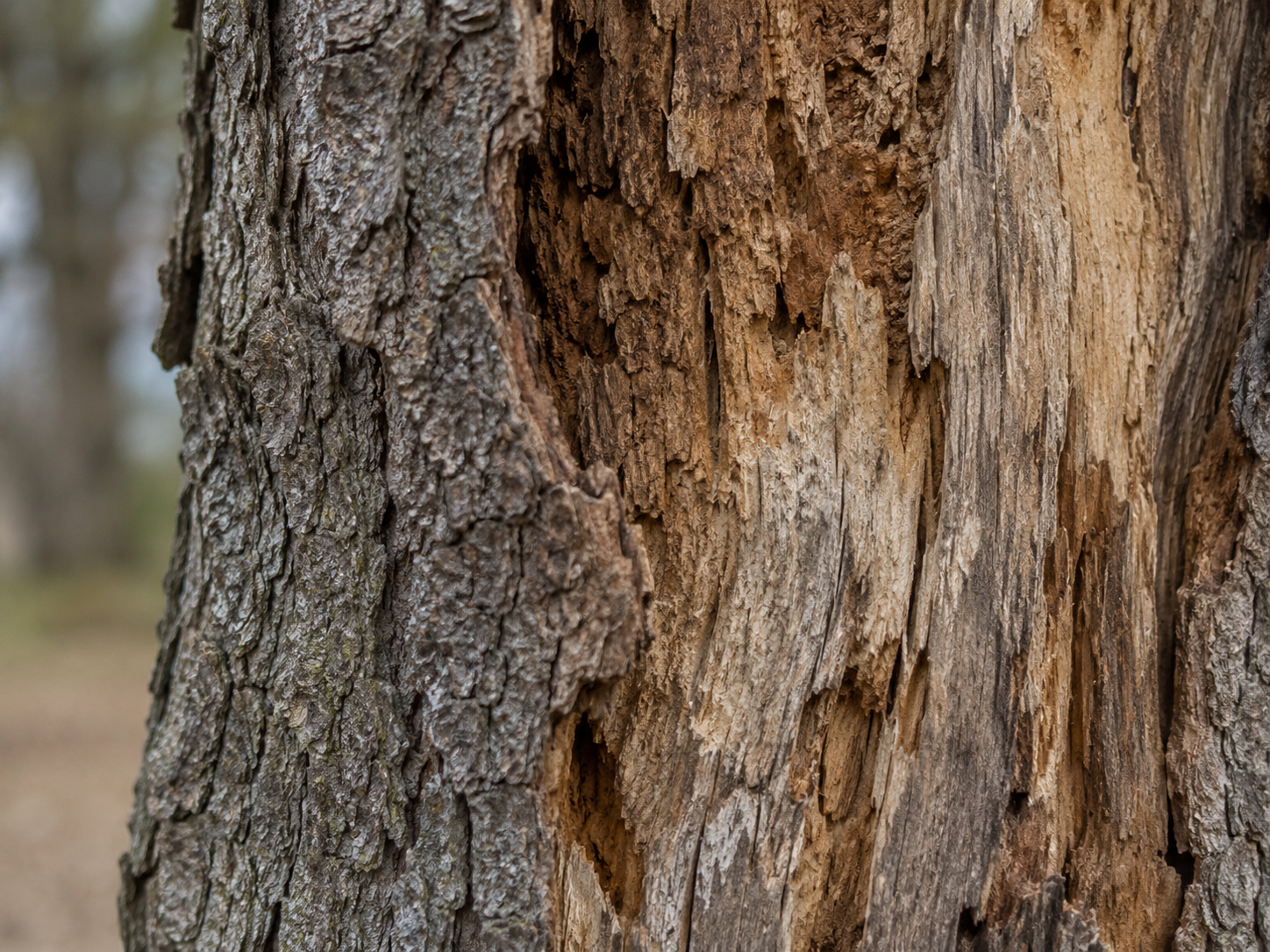
Healthy bark usually stays attached and consistent for the species. A dying or dead tree may have bark that is peeling away in large sections, cracking deeply, or falling off without new healthy tissue underneath.
Loose bark does not always mean the entire tree is dead. Some trees naturally shed bark as they grow. The concern is bark loss combined with other signs, such as no leaves, dead branches, cracks in the trunk, or fungal growth.
The trunk tells a bigger story than the outer branches. Cavities, soft wood, major splits, and hollow-sounding sections can all point to structural weakness. A tree with a compromised trunk may still produce leaves for a while, but that does not mean it is safe.
Do not pull bark off to investigate. If bark is loose, look at what is already exposed. Creating fresh wounds can make a stressed tree worse.
Dead branches are one of the clearest warning signs. They often appear dry, grey, cracked, or brittle. Smaller dead branches may snap easily in the wind, while larger limbs can become hazardous as decay moves through the wood.
A tree can survive with some deadwood, especially after storm damage or drought stress. The concern grows when dead branches are large, spreading through the canopy, or hanging over areas people use.
Common warning signs include dry twigs that snap easily, limbs with no buds, branches shedding bark, and sections of the canopy that no longer produce leaves. If these signs appear high in the tree or near heavy limbs, do not rely on a ladder and guesswork.
For Barrie homeowners dealing with dead limbs over driveways, yards, or rooflines, our article on Dead Limb Removal Barrie explains why deadwood should be handled before it breaks on its own.
After heavy snow, freezing rain, or strong wind, check the canopy from the ground. Freshly broken deadwood often reveals weak areas that were already declining.
Fungus around the trunk or root flare can signal decay. Mushrooms growing from the base of a tree, shelf fungus on the trunk, or soft wood near the ground should be taken seriously.
Not every mushroom in the lawn means the tree is dead. Fungi can live in soil, mulch, or old roots. The risk increases when fungal growth is attached to the trunk, growing from large roots, or appearing beside other symptoms like thinning leaves and dead limbs.
Decay at the base is especially important because that is where the tree carries its weight. If the lower trunk or major roots are compromised, the tree may become unstable even if part of the canopy still looks alive.

The scratch test can help confirm whether a smaller branch is alive. Use a clean fingernail or small knife to gently scratch the outer surface of a twig.
A living branch usually shows green or moist tissue underneath. A dead branch often looks dry, brown, and brittle all the way through.
Use the scratch test carefully:
The scratch test is useful, but it is not a full diagnosis. A tree can have living branches and still be structurally unsafe if the trunk, roots, or major limbs are failing.
A tree that suddenly leans is a serious warning sign. Soil lifting near the base, cracked ground, exposed roots, or a shifting root plate can mean the tree is losing stability.
Some trees naturally grow with a lean. The difference is movement. A long-standing lean may be manageable if the tree is otherwise healthy. A new lean after wind, rain, or construction should be assessed quickly.
Roots are easy to overlook because most of the system is underground. Damage from excavation, grade changes, compaction, drainage issues, and construction can weaken a tree even when the canopy still looks partly alive.
For Barrie properties where a tree may be dead, unstable, or affecting a structure, our Arborist Reports service can help document the condition and support the right decision.

A fully dead tree will not recover. Once the tree is dead, the decision becomes about timing, access, and safety.
Waiting usually makes removal harder. Dead wood becomes more brittle over time, and climbing or rigging the tree can become more dangerous. A dead tree near a house, garage, fence, hydro line, or public area should not be left until it fails.
In Barrie, our Tree Removal Service is the right next step when a dead or declining tree cannot be safely preserved through pruning.
For homeowners in Orillia, mature trees near older homes, cottages, and narrow lots may need careful removal planning when decay is present. Our Tree Removal Orillia page gives local context for removal support in that area.
In Midland and surrounding Simcoe County communities, dead trees close to sheds, lanes, and waterfront properties can create access challenges. Our Tree Removal Midland page outlines service support for homeowners dealing with unsafe trees.
A half-dead tree can be more complicated than a fully dead one. Part of the canopy may still produce leaves while another section is declining. That does not automatically mean the tree can be saved.
The decision depends on the cause of the dieback, the amount of live canopy remaining, the strength of the trunk, and the location of the tree. A tree with one dead branch may only need pruning. A tree with major trunk decay and half the canopy gone may be past practical care.
Good judgment matters because removing a tree too early can be unnecessary, but waiting too long can increase risk. When the signs are mixed, a professional assessment helps separate a health problem from a safety problem.
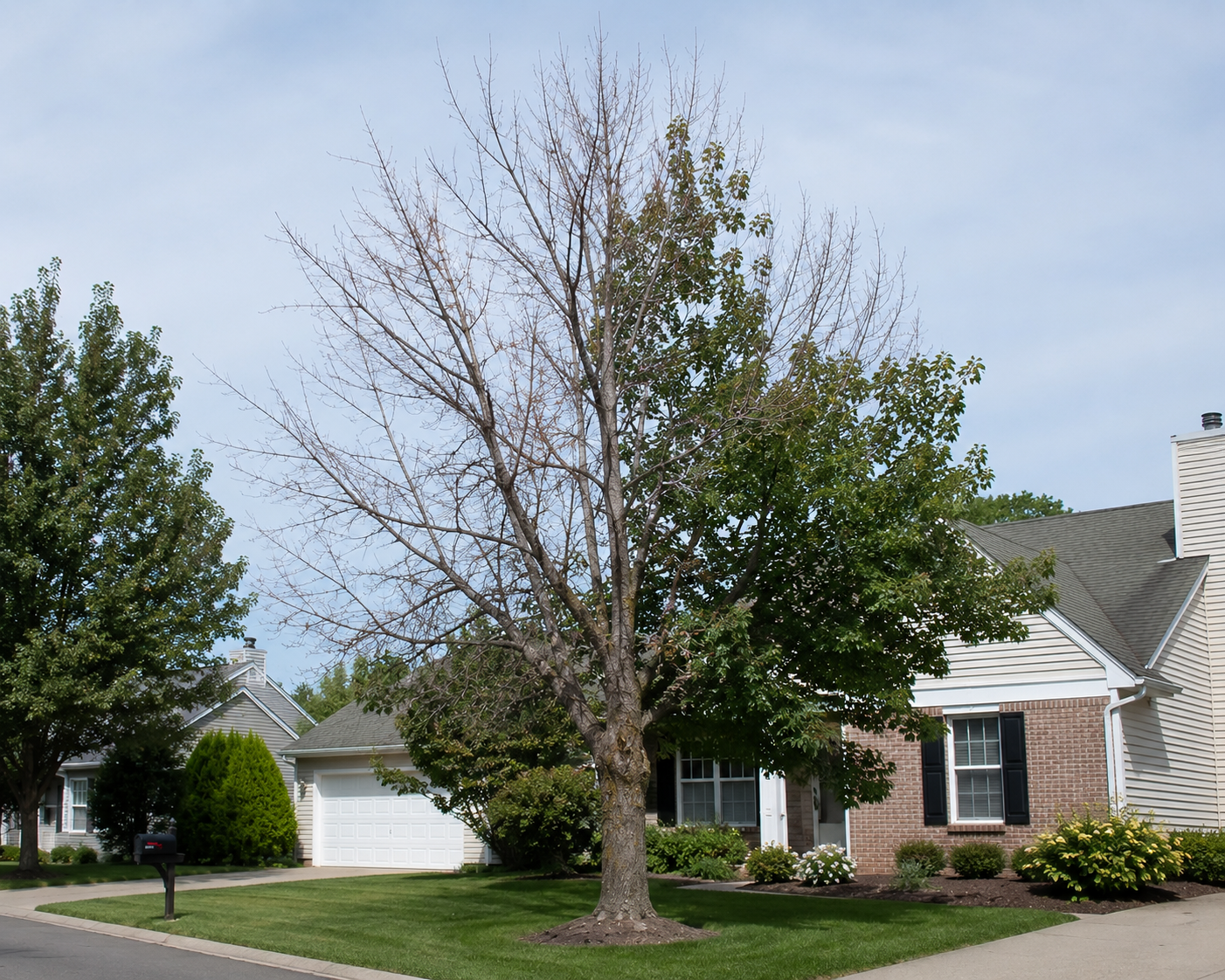
A dead tree usually shows more than one warning sign. Missing leaves, brittle limbs, peeling bark, trunk decay, fungal growth, root movement, and sudden leaning all matter more when they appear together.
Start with a ground-level inspection. Look at the canopy, branches, trunk, base, and surrounding soil. If the tree is near anything valuable or frequently used, do not wait for branches to start falling before taking action.
A tree that is only stressed may recover with the right care. A tree that is dead, unstable, or structurally compromised needs a safer plan before weather makes the decision for you.
Curious about tree trimming, stump grinding, or professional tree removal? Explore our website to learn more about how Tyler’s Tree Services can help keep your property safe and beautiful. Whether you need expert advice or a service quote, we’ve got you covered!

With nearly a decade of experience, we handle everything from precise trimming to safe removals, ensuring top-quality care.

Fully insured and WSIB certified, we follow strict safety standards to protect your property and our crew on every job.

We’re committed to expert service and clean results, ensuring you’re fully satisfied with every tree we trim or remove.

We are insured with $5M coverage ($2M per occurrence), ensuring a worry-free experience on every job you hire us for.
The information in this article was compiled from reputable public sources and interpreted by an expert copywriter for general educational purposes. While Tyler’s Tree Services makes every effort to provide accurate and up-to-date guidance on tree care and safety in Barrie & Simcoe County. Conditions can vary by property, tree species, and season. This content is not a substitute for a professional arborist’s inspection or advice. Tyler’s Tree Services and its authors are not responsible for any actions taken based on this article. For personalized tree care recommendations or safety concerns, we strongly recommend consulting a certified arborist
